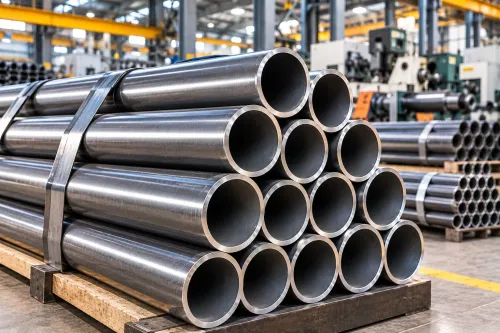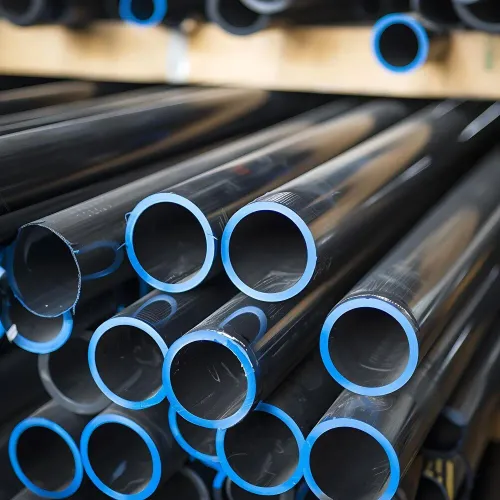
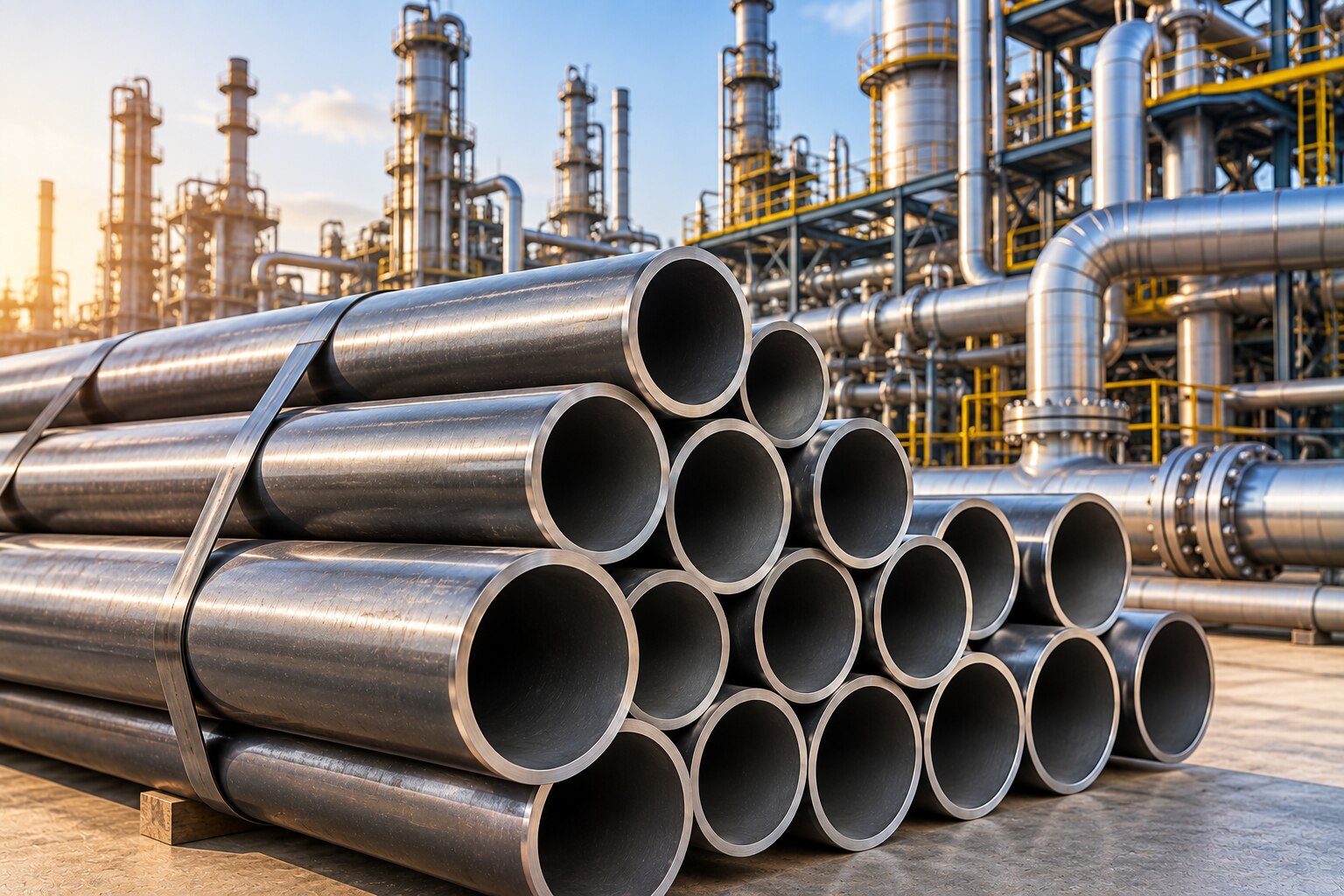
A high-temperature pipe order can fail even when the nominal size and alloy name look correct: P11 is not P22, A335 pipe is not A213 boiler tube, and “seamless” is not a complete quality specification. By the end, you will be able to compare grades, identify the correct ASTM or ASME product standard, prepare a usable purchase specification, and check traceability before the material reaches fabrication.
Key takeaways
- Use P11 or P22 for established chromium-molybdenum pressure-piping service.
- Choose P5 or P9 when higher chromium content supports oxidation resistance.
- Specify grade, wall thickness, dimensions, standard, heat treatment, and test documents.
- Verify markings, dimensions, certificates, chemistry, and condition before fabrication.
Which alloy steel grades suit high-temperature pressure piping?
ASTM A335 P11 and ASTM A335 P22 are established chromium-molybdenum choices for elevated-temperature pressure piping. ASTM A335 P5 and ASTM A335 P9 provide higher chromium content for improved oxidation resistance, while P91 uses a different creep-strength strategy and demands tighter fabrication control.
| Grade | Approximate alloying basis | Selection significance |
|---|---|---|
| ASTM A335 P5 | About 5% chromium with molybdenum | Oxidation resistance above conventional low-alloy grades; verify creep data at the design temperature |
| ASTM A335 P9 | About 9% chromium with molybdenum | Stronger oxidation resistance for hotter service, but not an automatic pressure rating |
| ASTM A335 P11 | About 1.25% chromium and 0.5% molybdenum | Established Cr-Mo piping grade for elevated-temperature systems |
| ASTM A335 P22 | About 2.25% chromium and 1% molybdenum | Greater high-temperature strength than P11 in suitable code applications |
| P91 | About 9% chromium with molybdenum, vanadium, and niobium | Higher creep strength, with strict control of welding, heat treatment, hardness, and service life |
The P22 and P91 differences are not a simple “lower” and “higher” ranking. Chromium supports oxidation resistance; molybdenum improves elevated-temperature strength; tungsten, where specified in an alloy system, can contribute to creep resistance. Match those effects to metal temperature, creep exposure, oxidation, process chemistry, thermal cycling, and intended life.
No grade name supplies a pressure or temperature rating. Use the governing design code’s allowable stresses, grade-specific data, wall calculation, and creep limits. A supplier’s “high-temperature” description cannot replace that engineering check.
Which standard and pipe construction belong in the system?
The product form follows the equipment specification, not the alloy name alone. ASTM A335/A335M or ASME SA335 covers seamless ferritic alloy-steel pipe for high-temperature pressure piping; ASTM A213/A213M covers seamless ferritic and austenitic tubing for boilers, superheaters, and heat exchangers.
Ordering A335 pipe when the equipment requires ASTM A213 boiler tubes can create a compliance failure despite similar chemistry.
| Option | What it means | When it applies |
|---|---|---|
| ASTM A335/A335M or ASME SA335 | Seamless ferritic alloy-steel pipe | High-temperature pressure piping |
| ASTM A213/A213M | Seamless alloy-steel tube | Boilers, superheaters, and heat exchangers |
| Specified welded product | Pipe made with a longitudinal or helical weld | When the design code and equipment specification permit it |
Seamless alloy steel pipe versus welded pipe is a design and inspection decision, not a claim that seamless material is defect-free. Define hydrostatic testing and any required ultrasonic, eddy-current, radiographic, or other examination in the order.
The rest of the pressure boundary must match the pipe. Specify ASTM A234/A234M butt-welding fittings and ASTM A182/A182M forged flanges and fittings alongside compatible valves, bolting, gaskets, branch outlets, and weld consumables.
Check grade, wall thickness, heat treatment, pressure-temperature rating, thermal expansion, and degradation mechanisms such as oxidation or sulfidation; matching nominal chemistry alone does not prove compatibility.
How should the grade be matched to the actual operating conditions?
The design engineer must define the complete service envelope before pipe selection; high-temperature pipe design cannot rely on grade name or operating temperature alone.
- State the design temperature, design pressure, fluid chemistry, contaminants, oxidation exposure, thermal-cycle frequency, and expected creep duration.
- Identify damage mechanisms, including carburization, decarburization, sulfidation, oxidation, erosion, and corrosion, at each operating condition.
- Specify the required creep strength, oxidation resistance, inspection basis, and service-life assumptions for the pressure boundary.
- Give startup and shutdown temperatures, heating and cooling rates, and any ambient-temperature exposure that could make toughness critical.
Nominal pipe size and schedule do not establish usable wall thickness. The code calculation must combine pressure requirements with corrosion allowance and wall thickness, erosion allowance, mill under-tolerance, threading or grooving losses, connection losses, and the specified actual outside diameter. State whether the order requires nominal wall or minimum wall, plus the permitted dimensional tolerance.
If low-temperature startup, shutdown, ambient exposure, or thermal cycling affects fracture risk, put the impact-test temperature and acceptance criteria in the purchase order. Name the supplementary specification and required test method; an alloy-steel grade alone does not guarantee impact data.
Give the supplier the process chemistry and transient conditions, not just the maximum temperature. A pipe that survives steady heat can still fail through sulfidation during contaminated service or cracking after repeated thermal cycles. Extend the same review to fittings, flanges, valves, bolting, gaskets, branch outlets, and weld consumables.
What should you write in an alloy steel pipe purchase specification?
A supplier-ready request must turn the design basis into measurable purchase data, not simply say “high-temperature alloy pipe.” Give the alloy steel pipe supplier the service temperature, pressure, fluid, corrosion or erosion allowance, design code, and connection method so the selected material can be checked against the calculation.
Use this pipe specification checklist:
- Nominal pipe size and schedule, plus actual outside diameter and nominal or minimum wall thickness
- Grade, such as ASTM A335 P11, P22, or P91
- ASTM A335/A335M or ASME SA335 specification and edition
- Random or fixed length, permitted dimensional tolerances, and end finish
- Required heat treatment and impact-test temperature and acceptance criteria, when low-temperature service makes toughness relevant
- Required nondestructive examination, hydrostatic test, and any ultrasonic, eddy-current, radiographic, or supplementary testing
- Mill test report, heat number, chemical analysis, mechanical properties, hardness where required, and traceability documents
Schedule alone does not establish usable wall: account for mill under-tolerance, corrosion or erosion allowance, and threading or grooving losses.
| Purchase detail | What it controls | What can go wrong if omitted |
|---|---|---|
| Pipe or tube status | A335 pressure pipe versus A213 boiler or heat-exchanger tube | Nonconforming product |
| Nominal or minimum wall | Design margin and fabrication allowance | Insufficient finished wall |
| End finish and tolerances | Fit-up, welding, and inspection | Delays or rejected joints |
Vikram And Company can act on a complete request by confirming pipe-versus-tube status, heat-number continuity, tolerances, and documentation instead of guessing from nominal size.
Related product
 | Alloy Steel Pipes & Products We supply alloy steel pipes as part of our alloy steel product range for industrial and project sourcing requirements. View product → |
How do you verify alloy pipe before fabrication and installation?
Release received pipe only when the mill test report, purchase order, and physical marking tell the same story. High-temperature pipe inspection is a traceability check as much as a visual examination.
- Confirm the specification and edition, grade, heat number, nominal size, outside diameter, wall thickness, length, and end condition against the purchase order and pipe marking.
- Check the reported heat treatment, chemical analysis, tensile strength, yield strength, and elongation. Verify hardness where the specification or project requires it.
- Confirm every supplementary test, such as ultrasonic examination, impact testing, or hydrostatic testing. If startup, shutdown, or ambient exposure makes toughness important, check the stated impact-test temperature and acceptance criteria.
- Follow heat number traceability from the pipe to the mill test report, inspection records, and fabrication cut pieces. A certificate without continuous heat identification cannot support release of critical piping.
- Segregate each grade and heat in storage, preserve its markings, and keep documents with the identified bundle. Do not mix P11, P22, P91, or carbon steel.
Carbon-steel shot blasting, uncontrolled grinding, contamination, or missing markings can remove identification or introduce unsuitable material. Quarantine affected pipe until engineering and quality personnel establish its identity and acceptability.
For P91, require documented preheat, interpass-temperature records, post-weld heat treatment, tempering, hardness checks, and qualified welding procedures. These controls limit hard microstructures and reduce premature creep damage and Type IV cracking risk in the heat-affected zone.
Frequently asked questions
Which alloy steel grades suit high-temperature pressure piping?
ASTM A335 P11 and P22 suit established chromium-molybdenum applications. P5 and P9 offer higher chromium content for improved oxidation resistance, while P91 requires tighter fabrication control for its creep-strength strategy.
Which standard and pipe construction belong in the system?
Specify ASTM A335 for seamless ferritic alloy-steel pipe, then define the grade, nominal size, schedule or wall thickness, dimensions, heat treatment, and required tests.
How should the grade be matched to operating conditions?
Match the grade to design temperature, pressure, steam or process-fluid chemistry, oxidation exposure, creep demand, weldability, and the governing design code.
What should you write in an alloy steel pipe purchase specification?
State the ASTM product standard and grade, size, wall thickness, length, end finish, heat-treatment condition, inspection requirements, marking, packing, and material-test documentation.
How do you verify alloy pipe before fabrication and installation?
Compare pipe markings with the order, inspect dimensions and surface condition, review heat numbers and test certificates, confirm chemistry and mechanical results, and resolve discrepancies before cutting or welding.