A heavy-duty pipe purchase fails when “seamless” is treated as a complete specification. You need to connect the manufacturing route to pressure, temperature, loading, corrosion, dimensions, testing, and the documents that prove the delivered pipe matches the design basis.
Key takeaways
- Use seamless pipe when weld-related failure risk exceeds its added cost.
- State outside diameter, wall thickness, length, grade, schedule and tolerance.
- Request the material test certificate, heat number and specified NDT reports.
- Compare corrosion controls and supplier traceability before approving the pipe.
When does a seamless pipe matter more than a welded pipe?
Choose carbon steel seamless pipe when a longitudinal weld creates a credible failure risk that your design code, operating conditions, or inspection plan cannot accept. The absence of that weld is not automatically worth the cost: seamless pipe can still contain wall-thickness eccentricity, laps, laminations, inclusions, and other mill discontinuities.
| Option | What changes | When it matters |
|---|---|---|
| ERW pipe | A longitudinal seam is formed and tested during manufacture | Suitable when the specification accepts welded construction and seam quality is demonstrated |
| Carbon steel seamless pipe | No longitudinal weld seam exists | Useful for high temperature, severe pressure cycling, thick-wall, or safety-critical service when the code or risk assessment favours it |
| Pressure service pipe | The service basis controls grade, dimensions, testing, and acceptance | Required when failure could release hazardous fluid or compromise containment |
Determine whether seamless versus welded pipe matters by checking four points:
- Design pressure and temperature: ASTM A106 is seamless carbon steel pipe for high-temperature service; ASTM A53 covers seamless and welded pipe for general mechanical and pressure applications. They are not interchangeable descriptions.
- Loading: repeated thermal cycles, vibration, bending, and rapid pressure changes increase the value of removing a weld seam.
- Inspection: require dimensional checks plus ultrasonic or other nondestructive examination when the service demands it; “seamless” does not mean defect-free.
- Service damage: wet hydrogen sulfide requires a NACE MR0175/ISO 15156 basis, including hardness, chemistry, and heat-treatment controls. API 5L ERW or seamless line pipe also requires a stated grade and PSL, not merely “API 5L carbon pipe.”
How do you write the pipe specification without dimensional mismatches?
State both the ordering designation and the dimensions that control fabrication: NPS, outside diameter, schedule or wall thickness, and the governing dimensional standard. “6-inch pipe” is unsafe shorthand; NPS 6 Schedule 40 has a 168.3 mm outside diameter, a nominal 7.11 mm wall, and an approximate 154 mm bore.
| Field | Put on the purchase specification | Why it prevents mismatch |
|---|---|---|
| Size and wall | NPS 6; outside diameter 168.3 mm; Schedule 40; nominal wall 7.11 mm; wall thickness tolerance and minimum accepted wall | Separates nominal size from measured bore and verifies remaining pressure wall |
| Grade | ASTM A106 Grade B, or API 5L Grade X52 PSL 2 with delivery condition | “A106 seamless” and “API 5L” do not identify a complete material |
| Ends | Plain, beveled, or threaded; state bevel angle and root face when welding | Prevents ends arriving unsuitable for joining |
| Length | Random, double-random, or fixed cut length, with permitted length tolerance | Controls fit-up, waste, and handling |
| Design condition | Design pressure, design temperature, fluid, corrosion allowance, and applicable design code | Schedule selection depends on service, not diameter alone |
Add the required examination and documentation, such as ultrasonic testing, heat number, and material test certificate, when the service demands them. If low-temperature or cyclic service matters, specify Charpy test temperature, minimum absorbed energy, specimen orientation, and test standard.
Record the theoretical mass as a planning figure, not a delivered guarantee: NPS 6 Schedule 40 is about 28.3 kg/m, while permitted wall and mass tolerances affect lifting, supports, transport, and fabrication loads.
Which standard and test documents prove the pipe is fit for service?
“ASTM A106 Grade B” identifies seamless carbon steel pipe for high-temperature service; “ASTM A53” covers seamless and welded pipe for general mechanical or pressure use. They are not interchangeable. API 5L is a line-pipe procurement category, so “API 5L carbon seamless” remains incomplete without grade, PSL, delivery condition, dimensions, and tests.
| Standard or document | What changes in the received pipe | Evidence to request |
|---|---|---|
| ASTM A106 Grade B | High-temperature seamless-pipe chemistry and mechanical requirements | Heat-treated mill certificate with chemistry, yield, tensile, elongation, hydrostatic results |
| ASTM A53 | General-service requirements; construction may be seamless or welded | Grade, type, hydrostatic test, and manufacturing designation |
| API 5L PSL 1 | Basic line-pipe chemistry, mechanical, dimensional, and test controls | API certificate, heat number, grade, PSL, and test results |
| API 5L PSL 2 | Tighter chemistry, toughness, hardness, testing, and traceability controls | Complete PSL 2 certificate, Charpy results where specified, and full heat traceability |
ASME B36.10M controls dimensions, not whether the material suits your pressure or temperature. Your design code, such as ASME B31.3, sets service calculations and acceptance criteria. For wet hydrogen-sulfide service, specify NACE MR0175/ISO 15156; hardness limits, chemistry, heat treatment, and qualification can change the order.
Demand an EN 10204 3.1 certificate tied to each heat and pipe bundle. Specify hydrostatic testing, ultrasonic or eddy-current examination, and visual, dimensional, and wall-thickness inspection. State Charpy temperature, absorbed-energy minimum, specimen orientation, and test standard for low-temperature or fracture-critical service; seamless construction alone proves none of these.
Check permitted wall loss too: a nominal 10.0 mm wall with a 12.5% negative tolerance can measure about 8.75 mm before corrosion allowance.
Where does seamless carbon steel work, and when is another pipe better?
Seamless carbon steel suits steam and condensate lines, hydraulic service, and process piping carrying dry, non-corrosive fluids at elevated pressure or temperature. ASTM A106 is the usual high-temperature choice; ASTM A53 fits broader mechanical and pressure duties where its service basis is acceptable.
| Option | What changes | When it applies |
|---|---|---|
| Seamless carbon steel | No longitudinal weld; strong pressure and temperature basis | High-temperature, cyclic, or safety-critical service |
| Welded carbon steel | Welded construction, often lower cost and broader size availability | Utility lines, moderate-duty process piping, and large diameters when the weld specification is acceptable |
| Fabricated pipe | Plate or sections formed and welded to a required shape | Very large diameters, nonstandard dimensions, headers, ducting, and spool assemblies |
| Stainless or alloy steel | Better resistance to corrosion, oxidation, or high temperature | Chlorides, wet process fluids, sour environments, or temperatures beyond carbon steel’s design basis |
| Lined pipe | Carbon-steel strength with an internal polymer, rubber, or glass lining | Fluids that attack carbon steel but do not exceed the lining’s temperature or abrasion limits |
| Non-metallic pipe | Plastic, reinforced polymer, or composite construction | Chemically aggressive, lightweight, or low-temperature service where pressure, fire, permeation, and impact limits are acceptable |
Do not confuse a seamless tube versus pipe decision: hydraulic instrumentation often needs tube dimensions and fittings, while process lines use NPS pipe dimensions. Choose welded or fabricated construction when diameter, cost, or geometry outweighs weld-free construction.
How should you control corrosion and evaluate a pipe supplier?
Treat the nominal wall as a starting point, not remaining service life. A common ASTM carbon-steel pipe tolerance is minus 12.5%; a 10.0 mm nominal wall could measure about 8.75 mm before corrosion allowance, so calculate against permitted minimum wall and verify it on receipt.
Corrosion allowance is a design provision, not corrosion control. Base it on the fluid, temperature, velocity, water content, CO2, and H2S exposure, then select compatible coating, lining, inhibitor, drainage, and inspection intervals. A galvanised pipe can protect exposed steel in suitable environments, but it is not a substitute for high-temperature or sour-service material evaluation.
Ask the supplier for these controls:
- Heat number marked on each bundle and traceable to the purchase order, pipe size, grade, and test results.
- EN 10204 Type 3.1 certificate for manufacturer-reported chemistry, mechanical results, and heat identification; specify EN 10204 Type 3.2 when an authorised purchaser’s representative or official inspector must validate the results.
- Incoming checks for outside diameter, length, ovality, end condition, and ultrasonic or mechanical wall-thickness readings against the permitted minimum.
- Records showing segregation of heats, calibrated measuring equipment, nondestructive testing, and corrective action for rejected pieces.
Before ordering, compare the supplier’s quotation with your exact grade, schedule, standard, delivery condition, and inspection plan. Vikram And Company can be asked to attach heat-wise certificates and dimensional inspection records to the commercial documents, preventing an apparently similar pipe from entering the project under the wrong designation.
Related products
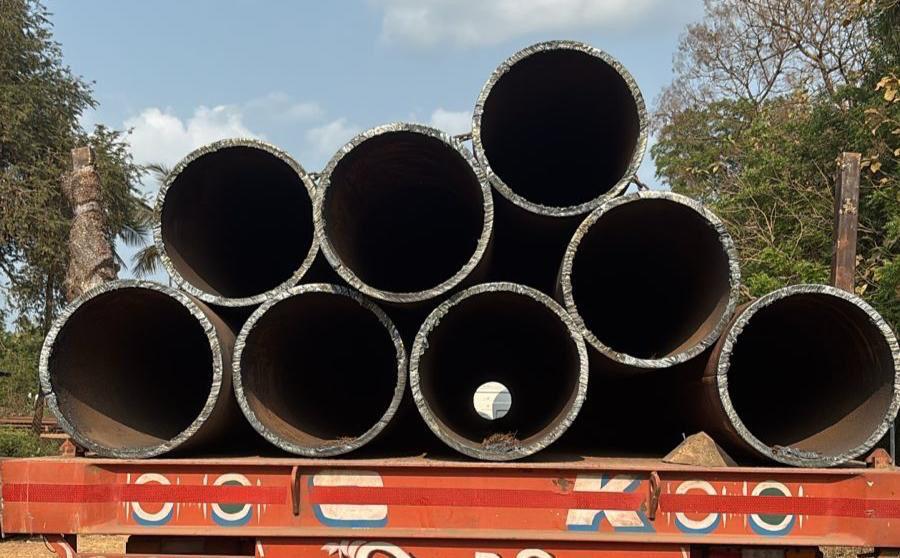 | Seamless Pipes We supply MS/CS seamless pipes for customers seeking seamless pipe solutions for industrial and project requirements. View product → |
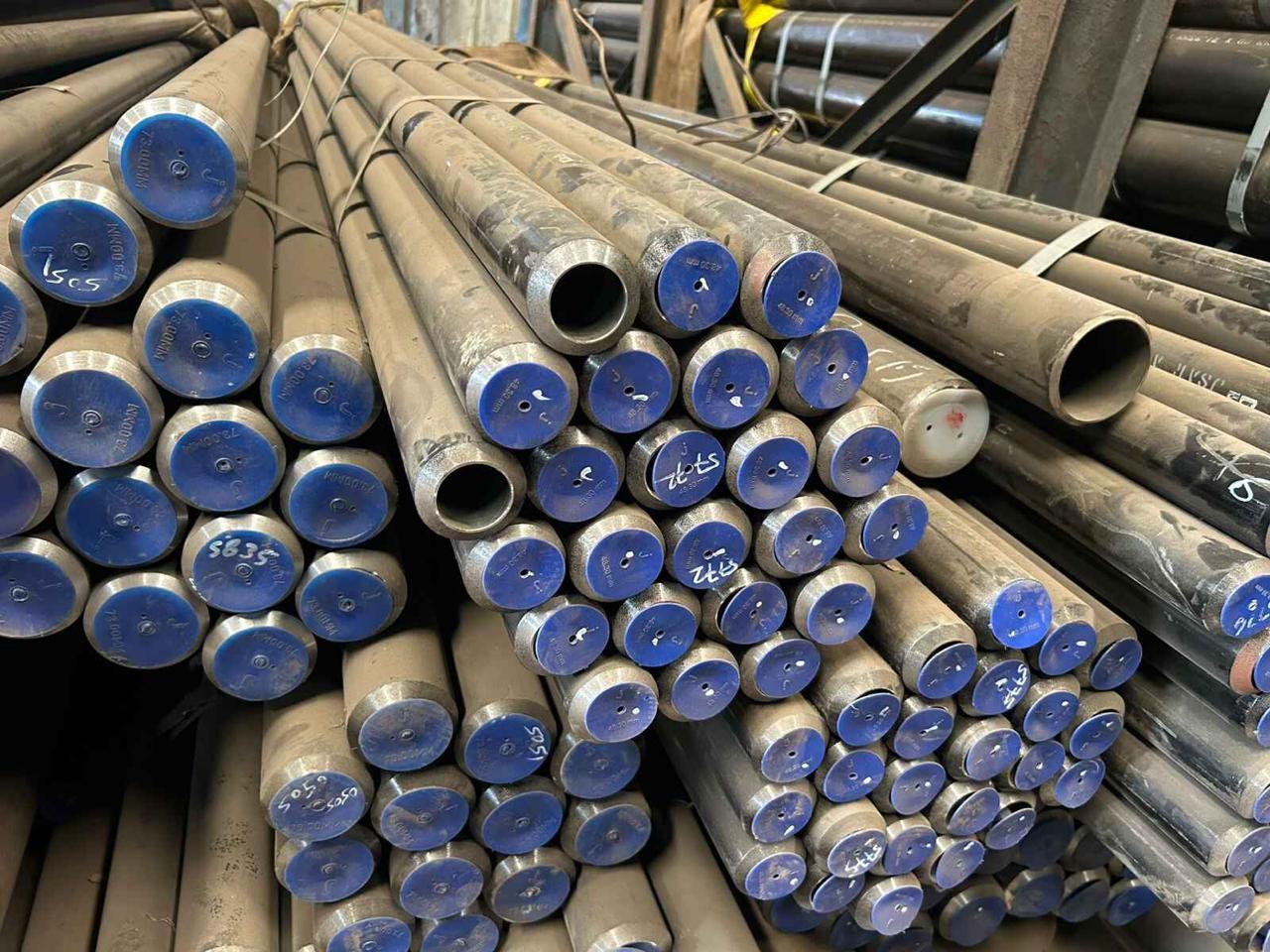 | Seamless Tubes We supply seamless tubes as part of our industrial pipe and tube range. View product → |
Frequently asked questions
When does seamless pipe matter more than welded pipe?
Seamless pipe matters when a longitudinal weld creates a failure risk that the design code, service conditions or inspection plan cannot accept. It does not eliminate mill defects or automatically justify the higher cost.
How do you write a pipe specification without dimensional mismatches?
State the outside diameter, wall thickness or schedule, length, dimensional tolerances, material grade, end finish and quantity. Keep nominal bore, outside diameter and wall thickness as separate requirements.
Which standards and test documents prove pipe fitness for service?
Match the pipe standard to the service and request the material test certificate, heat number, chemical and mechanical results, dimensional inspection records and specified nondestructive testing reports.
Where does seamless carbon steel work, and when is another pipe better?
Seamless carbon steel suits pressure, temperature and heavy-duty industrial service when its grade and wall thickness meet the design basis. Welded pipe can be the better choice for large diameters, lower cost or applications covered by an accepted welded-pipe standard.
How should you control corrosion and evaluate a pipe supplier?
Specify the corrosion allowance, coating or lining, storage protection and inspection method. Evaluate the supplier through traceability, certificates, dimensional checks, testing capability and evidence that delivered pipe matches the purchase specification.