A quotation marked only “MS pipe” leaves critical decisions unresolved: size, wall thickness, manufacturing route, grade, testing and traceability can all change whether the material is suitable for your job. Use the checks below to compare stockists against the specification you actually need, not just against the lowest quoted price.
Key takeaways
- Put grade, standard, dimensions, ends, length and quantity in your enquiry.
- Confirm outside diameter and wall thickness, not nominal size alone.
- Match the manufacturing route and test certificate to the project specification.
- Inspect heat numbers, pipe condition, documents and delivery controls before acceptance.
Start with a Complete, Comparable Pipe Specification
Put the complete specification in your enquiry before asking any MS pipe stockist for a price. State the product standard, grade, manufacturing route, outside diameter, nominal bore, wall thickness and schedule, end finish, length, quantity, surface condition, and required inspection documents.
1. Name the governing standard and application. Specify IS 1239, IS 3589, IS 4923, ASTM A53 or ASTM A106 as applicable, and state whether the pipe is for pressure, process, water, fabrication or structural service. ASTM A106 seamless pipe is not interchangeable with ASTM A500 structural tubing merely because both are carbon steel.
2. Give both nominal and actual dimensions. State the nominal bore or NPS, outside diameter, wall thickness or schedule, permitted dimensional tolerances, and required length tolerance. Nominal bore alone does not identify the delivered OD or wall.
3. Define the manufacturing route and ends. Ask for seamless, ERW or another welded route, plus plain, bevelled, threaded or grooved ends. A stockist quoting only “MS pipe” leaves the route open to substitution.
4. State the deliverable condition. Identify bare, painted or hot-dip galvanized pipe, and say whether coating is mill-applied, stockist-applied or post-fabrication. Request coating thickness, continuity and repair requirements when galvanized pipe is required.
5. Add acceptance and supply details: heat-wise test certificate, chemical and mechanical results, available quantity from one heat, pieces per length, stock condition and any proposed substitution. This MS pipe stockist checklist makes quotations comparable rather than merely cheap.
Match Nominal Size to the Actual Delivered Dimensions
A quotation for 100 NB or NPS 4 pipe does not, by itself, identify the pipe you need. Treat nominal pipe size versus actual outside diameter as separate entries: confirm the specified OD, wall thickness or schedule, governing standard and permitted dimensional tolerances.
Ask the stockist to show these details on the quotation:
- Nominal bore or NPS, actual outside diameter and wall thickness
- Fixed length, such as 6,000 mm, or random length with the offered length range
- Total quantity, number of pieces, and quantity available in each length
- End condition, such as plain, bevelled or threaded, if it affects fit-up
- Coating condition, including whether the pipe is uncoated or galvanized
A schedule changes wall thickness while the outside diameter stays fixed in many carbon-steel pipe systems. Do not approve “same size” substitutions without checking the resulting internal diameter, mass per metre, thread engagement and fit with flanges or fittings.
Length deserves its own check. A fixed length supports cutting plans and reduces waste; random length can leave short pieces unusable for supports, spools or structural members. State the minimum and maximum acceptable length, then compare the stockist’s piece-by-piece quantity rather than accepting only a total metre figure.
At receipt, count the pipes, measure sample OD and length, and check wall thickness against the standard’s tolerance. Record shortages or out-of-tolerance pieces before fabrication; installation cannot correct a wrong dimension.
Choose the Correct Standard and Manufacturing Route
Select the standard from the service, not from the stockist’s available size. State the grade, manufacturing route, outside diameter or nominal bore, wall thickness or schedule, end finish and required tests in the quotation; “MS pipe” leaves too much open.
| Standard | Product family | Manufacturing route and suitable use |
|---|---|---|
| IS 1239 | Steel tubes for water, gas, air and steam services | Specify the applicable part, class and end finish; commonly used for utility piping |
| IS 3589 | Steel pipes for water, gas and sewage service | Use for larger-diameter welded pipe where the project specification names this standard |
| IS 4923 | Hollow steel sections for structural use | Use for columns, trusses and frames, not pressure or process piping |
| ASTM A53 | General-purpose carbon-steel pipe | Welded or seamless; use only when the service and project permit its grade and route |
| ASTM A106 | Seamless carbon-steel pipe for high-temperature service | Select for specified pressure and temperature conditions; it is not a substitute for A53 |
ERW is an electric-resistance-welded form of welded pipe. Choose it for compatible water, utility or structural duties when the standard permits it; require seamless pipe when the design, temperature, pressure or specification demands no weld seam. Seamless is not automatically better.
Do not substitute IS 4923 or ASTM A500 structural tubing for pressure pipe because the dimensions look right. Ask the quotation to identify hydrostatic testing, ultrasonic or electromagnetic examination, visual inspection, certificate type, and whether results apply per heat, lot or individual length. State tighter project tolerances when standard tolerances are insufficient.
Use Grade, Test Results and Traceability as Acceptance Checks
A certificate that says only “MS grade” does not prove what arrived. Accept the pipe only when the material test certificate names the product standard, grade, dimensions, manufacturing route, heat or cast number, and actual test results.
- Match the heat or cast number on the certificate with the stencil, tag, or bundle label. Record the number against each delivered bundle; a generic certificate without this link is weak evidence and may fail client handover.
- Check the reported chemistry, including carbon content, against the specified grade and calculate the applicable carbon equivalent when welding, thick sections, restrained joints, low-temperature service, or a qualified welding procedure makes weldability critical.
- Confirm the mechanical results show the required yield strength, tensile strength, and elongation percentage, with units and test direction stated. Do not accept a pass/fail statement when the specification requires actual values.
- Match the quoted inspection regime to the standard and purchase order. Hydrostatic testing, ultrasonic or electromagnetic examination, and visual inspection are separate checks; request the result for the stated heat, lot, or individual length.
If pieces are cut from a marked bundle, require transfer of the heat number, grade, and standard marking to each piece, or obtain a piece-level cutting and traceability report. For doubtful records, quarantine the material and use an independent laboratory or inspection agency before fabrication.
A certificate becomes useful only when its identifiers, dimensions, chemistry, mechanical results, and test records all point to the same pipe.
Audit the Stockist’s Documents, Stock Condition and Delivery Controls
A dependable stockist gives you a document chain, not a generic certificate. Match the purchase specification to the mill test certificate, heat number, product standard, dimensions and actual chemical and mechanical results.
Require the inspection release note to state whether hydrostatic testing, ultrasonic or electromagnetic examination, and visual inspection were completed separately, and whether results apply per heat, per lot or per individual length.
| Certificate type | What it proves | Approval implication |
|---|---|---|
| EN 10204 3.1 | Manufacturer’s release and test results, validated by its authorised inspection representative | Suitable when the purchase specification requires manufacturer-certified results |
| EN 10204 3.2 | 3.1-level information plus validation by the purchaser’s authorised representative or designated inspector | Use when the client, code or project requires independent witness or approval |
| Generic grade certificate | Grade is named without heat, actual results or delivery linkage | Difficult to accept, fabricate against or defend during handover |
Inspect bundles before signing an unqualified delivery receipt. Reject unexplained pitting, chloride contamination, dents from damaged slings, wet-ground storage marks and missing stencil transfers. Cut lengths need the heat, grade and standard transferred to each piece, or a piece-level cutting and traceability report.
Check that invoice traceability links each bundle to the delivery note and certificate. For galvanized pipe, confirm whether coating was mill-applied or stockist-applied, then verify continuity, damage repairs and fit-up allowance; “galvanized” alone states no coating thickness. Vikram And Company can be assessed on these same records when comparing seamless or round-pipe supply.
Related products
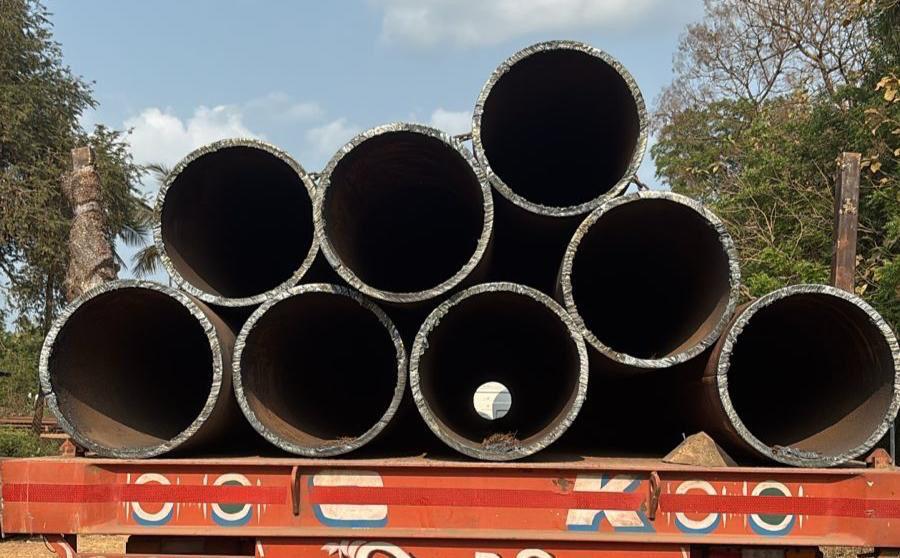 | Seamless Pipes We supply MS/CS seamless pipes for customers seeking seamless pipe solutions for industrial and project requirements. View product → |
 | MS Pipes We supply mild steel round pipes for industrial and project-related sourcing requirements. View product → |
Frequently asked questions
What should you include in an MS pipe enquiry?
State the product standard, grade, manufacturing route, outside diameter, nominal bore, wall thickness, schedule, end finish, length, quantity, surface condition and required inspection documents.
Why must you check actual delivered pipe dimensions?
Nominal bore and schedule identify a pipe size class, but the delivered outside diameter and wall thickness determine fit-up, flow space, weight and compliance.
How do you choose the correct MS pipe standard and manufacturing route?
Match the standard and route to the service, joining method, pressure or structural duty, and project specification. Do not substitute ERW, seamless or welded pipe without approval.
Which documents help verify MS pipe grade and traceability?
Review the mill test certificate for grade, heat number, chemical composition, mechanical test results, dimensions and standard. Match its heat number to the pipe markings and delivery documents.
What should you inspect when auditing an MS pipe stockist?
Check document control, heat-number traceability, storage conditions, corrosion, dents, ovality, end damage, quantity, packing and the stockist’s ability to meet the agreed delivery schedule.
Related product
 | MS Pipes We supply mild steel square pipes as part of our MS piping range for industrial, commercial, and project sourcing requirements. View product → |