Business logo
Home
About
About UsFAQ
Products
Alloy Steel Pipes & ProductsGI PipesMS PipesSeamless PipesSeamless TubesView All
Latest News
Gallery
Photos
More
Download Vikram And Company Android App⚡
Contact
08048035580
Home
About UsFAQ
Alloy Steel Pipes & ProductsGI PipesMS PipesSeamless PipesSeamless TubesView All
Latest News
Photos
Download Vikram And Company Android App⚡
Contact
08048035580
  1. Home>
  2. Latest News

Latest updates

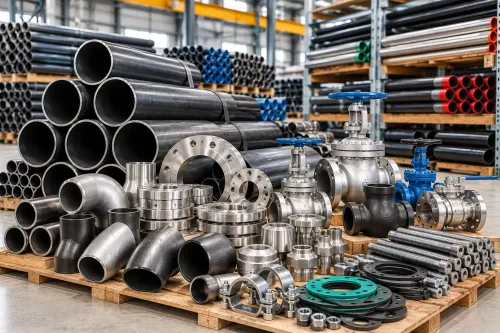
Piping Material Supplier for Industrial and Infrastructure Projects

A pipe that matches the nominal size can still fail the project if its grade, wall thickness, end preparation, coating, or certification does not match the service. By the end, you will be able to define the duty, compare pipe materials and manufacturing routes, write a complete purchase specification, and check supplied material before installation.

Key takeaways

  • Match pipe material to pressure, temperature, fluid, corrosion, and structural loads.
  • Specify grade, wall thickness, outside diameter, ends, length, and standard.
  • Confirm coating and galvanizing requirements before fabrication or installation.
  • Check heat numbers, test certificates, dimensions, and traceability at receipt.

Define the Service Before Choosing the Pipe

A pipe is suitable only when its material, wall, joints, and protection match the service and site. Piping material selection must start with design pressure, temperature, fluid service, corrosion exposure, soil conditions, and structural loads—not with “carbon steel” or “Schedule 40” alone.

Confirm these inputs before requesting a quotation:

  • State the design pressure and pressure rating, including surge, vacuum, and the governing code. Schedule identifies a…
Read updateOct 28th, 2026 10:30 AM

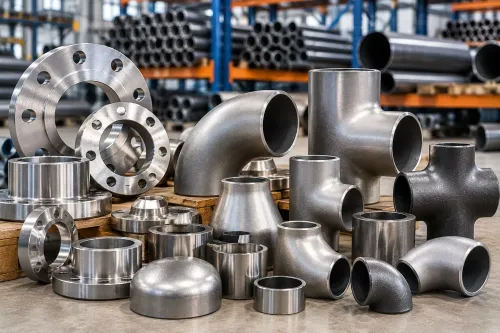
Pipe Fittings Supplier for Efficient Industrial Piping Systems

A piping system fails at its connections when fittings do not match the pipe’s size, wall, pressure-temperature duty, material, or installation method. By the end, you will be able to plan the route, specify each fitting, compare connection and material options, and check whether a supplier’s delivered documents and markings support the job.

Key takeaways

  • Match each fitting to pipe outside diameter, wall schedule, and pressure class.
  • Choose welded, threaded, flanged, or grooved connections for the service and maintenance plan.
  • Request material certificates, dimensional checks, and pressure-test records before ordering.
  • Inspect alignment, joint preparation, torque, and support placement before commissioning.

How fittings complete an industrial piping route

An industrial piping system needs pipe fittings wherever the route changes direction, branches, changes size, joins sections, or ends. Place each fitting from the process layout, flow direction, maintenance access, and support plan—not wherever a straight pipe happens to finish.

  • Elbows turn the route; specify the bend angle and radius because a short-radius elbow creates more pressure loss and flow disturbance than a long-radius elbow.
  • Tee…
Read updateOct 26th, 2026 12:30 PM

Steel Pipe Supplier for Construction and Industrial Applications

Choosing a steel pipe is a design and purchasing decision, not a search for the lowest quoted size. By the end, you will be able to match material and construction to the service, specify dimensions without ambiguity, compare supplier documents, and avoid costly errors in fabrication, testing, and delivery.

Key takeaways

  • Use GI for compatible atmospheric exposure, not hot, abrasive, or aggressive chemical service.
  • Specify nominal size, wall thickness, service conditions, and the governing pipe standard.
  • Confirm mill certificates, heat numbers, quantities, and delivery condition before dispatch.
  • Separate dissimilar metals and protect pipe ends, coatings, and interiors during storage.

Match the steel to the job: GI, MS, carbon steel, or alloy steel

Choose GI pipe when the zinc coating can protect against atmospheric moisture and the service is not hot, highly abrasive, or chemically aggressive. Galvanizing is not a substitute for selecting a compatible material: damaged coating, trapped water, or contact with dissimilar metals can still cause corrosion.

MS pipe and mild steel pipe usually refer to low-carbon steel used for general fabrication, supports, handrails, gates, frames, and…

Read updateOct 24th, 2026 10:00 AM

Industrial Steel Pipe Supplier for Reliable Piping Solutions

A reliable piping purchase starts with the service, not the stock list: pressure, temperature, fluid, corrosion exposure, flow rate and installation conditions determine the product you need. By the end, you will be able to write an unambiguous pipe specification, compare standards and manufacturing routes, and check whether a supplier’s documents prove that the delivered material matches your design.

Key takeaways

  • Specify pressure, temperature, fluid composition and corrosion risk before choosing pipe.
  • Confirm outside diameter, wall thickness, length and schedule—not nominal size alone.
  • Match the grade, standard and manufacturing route to the service and fabrication method.
  • Request heat-specific test records and compare them with the purchase specification.

Choose the Pipe Around the Service Conditions

A pipe is selected from service conditions, not nominal size alone. Record the fluid or gas composition, operating pressure, design pressure, temperature range, flow rate, corrosion or erosion risk, and indoor or outdoor exposure. For structural work, replace fluid data with axial load, bending, buckling, connection method and fire exposure.

ApplicationStarting specificationCheck before…
Read updateOct 22nd, 2026 12:00 PM

Alloy Steel Tube Supplier for Engineering and Manufacturing Needs

Choosing an alloy steel tube starts with service conditions, not the word “alloy” on a quotation. By the end, you will be able to match alloying elements and product standards to an application, compare seamless with welded construction, and give a supplier a specification that can be checked against the delivered material.

Key takeaways

  • Separate alloy, carbon and stainless steel by composition and service behaviour.
  • Match chromium, molybdenum, nickel and heat treatment to operating conditions.
  • Specify the product standard, manufacturing route, dimensions and inspection documents.
  • State grade, size, wall thickness, delivery condition and test requirements clearly.

What makes alloy steel tube different from carbon and stainless steel?

Alloy steel tube is carbon-based steel deliberately modified with elements beyond carbon and manganese. Those additions change strength, hardness, toughness, weldability and behaviour at high temperature. In metallurgical terms, stainless steel is also alloy steel; purchasing practice separates stainless grades because their chromium content delivers a distinct corrosion-resistant structure.

  • Chromium improves hardenability, oxidation resistance and…
Read updateOct 19th, 2026 12:01 PM

Alloy Steel Pipe Supplier for High-Temperature Industrial Systems

A high-temperature pipe order can fail even when the nominal size and alloy name look correct: P11 is not P22, A335 pipe is not A213 boiler tube, and “seamless” is not a complete quality specification. By the end, you will be able to compare grades, identify the correct ASTM or ASME product standard, prepare a usable purchase specification, and check traceability before the material reaches fabrication.

Key takeaways

  • Use P11 or P22 for established chromium-molybdenum pressure-piping service.
  • Choose P5 or P9 when higher chromium content supports oxidation resistance.
  • Specify grade, wall thickness, dimensions, standard, heat treatment, and test documents.
  • Verify markings, dimensions, certificates, chemistry, and condition before fabrication.

Which alloy steel grades suit high-temperature pressure piping?

ASTM A335 P11 and ASTM A335 P22 are established chromium-molybdenum choices for elevated-temperature pressure piping. ASTM A335 P5 and ASTM A335 P9 provide higher chromium content for improved oxidation resistance, while P91 uses a different creep-strength strategy and demands tighter fabrication control.

GradeApproximate alloying basisSelection significanceASTM A335 P5About 5% chromium…
Read updateOct 16th, 2026 12:30 PM

Carbon Steel Seamless Pipe Supplier for Heavy-Duty Applications

A heavy-duty pipe purchase fails when “seamless” is treated as a complete specification. You need to connect the manufacturing route to pressure, temperature, loading, corrosion, dimensions, testing, and the documents that prove the delivered pipe matches the design basis.

Key takeaways

  • Use seamless pipe when weld-related failure risk exceeds its added cost.
  • State outside diameter, wall thickness, length, grade, schedule and tolerance.
  • Request the material test certificate, heat number and specified NDT reports.
  • Compare corrosion controls and supplier traceability before approving the pipe.

When does a seamless pipe matter more than a welded pipe?

Choose carbon steel seamless pipe when a longitudinal weld creates a credible failure risk that your design code, operating conditions, or inspection plan cannot accept. The absence of that weld is not automatically worth the cost: seamless pipe can still contain wall-thickness eccentricity, laps, laminations, inclusions, and other mill discontinuities.

OptionWhat changesWhen it mattersERW pipeA longitudinal seam is formed and tested during manufactureSuitable when the specification accepts welded construction and seam quality is demonstratedCarb…
Read updateOct 14th, 2026 12:30 PM

Why Choose a Seamless Steel Tube Supplier for Engineering Projects

A seamless tube removes the longitudinal weld found in ERW and other welded products, but that feature alone does not prove pressure capability, corrosion resistance, or code compliance. You will be able to decide when seamless construction earns its higher cost, define the tube precisely, and check whether the supplier’s documents support your engineering requirements.

Key takeaways

  • Choose seamless tube for pressure, thermal cycling, or critical service conditions.
  • Reject seamless tube when welded tube meets the design code and lowers cost.
  • Specify grade, outside diameter, wall thickness, length, end finish, and test requirements.
  • Request mill certificates, heat numbers, traceability records, and inspection results.

What does seamless construction change in engineering service?

Seamless construction removes the longitudinal weld and its weld-affected zone from the tube wall. A seamless steel tube is pierced and formed from a solid steel billet, rather than rolled from strip joined along a longitudinal weld. That removes one source of seam discontinuities, weld-zone corrosion, and inspection concerns during repeated pressure or thermal cycling.

This is why engineers consider seamless tube…

Read updateOct 12th, 2026 12:32 PM

Seamless Pipe Supplier for High-Performance Industrial Applications

A seamless designation alone does not tell you whether a pipe will survive pressure, heat, corrosive chemicals, cyclic loading, or low-temperature service. You will be able to match the manufacturing route, material grade, dimensions, testing, documentation, and delivery controls to the actual duty before approving a supplier or accepting a shipment.

Key takeaways

  • Define pressure, temperature, chemistry, loads, and dimensions before choosing pipe.
  • Choose seamless or welded pipe according to duty, code, inspection, and availability.
  • Match grade, outside diameter, schedule, wall thickness, and standard to the design.
  • Verify certificates, heat numbers, dimensions, surface condition, and traceability before acceptance.

What Makes a Pipe Suitable for High-Performance Service?

Define the service envelope before seamless pipe selection: design pressure, design temperature, fluid chemistry, flow-related damage, loading, and required dimensions. In high-performance industrial applications, suitability comes from matching each limit to the governing code and material—not from the word seamless alone.

Service conditionWhat to defineWhy it changes the choicePressureDesign pressure, outside diameter…
Read updateOct 10th, 2026 12:03 PM

Key Factors to Consider When Selecting an MS Pipe Stockist

A quotation marked only “MS pipe” leaves critical decisions unresolved: size, wall thickness, manufacturing route, grade, testing and traceability can all change whether the material is suitable for your job. Use the checks below to compare stockists against the specification you actually need, not just against the lowest quoted price.

Key takeaways

  • Put grade, standard, dimensions, ends, length and quantity in your enquiry.
  • Confirm outside diameter and wall thickness, not nominal size alone.
  • Match the manufacturing route and test certificate to the project specification.
  • Inspect heat numbers, pipe condition, documents and delivery controls before acceptance.

Start with a Complete, Comparable Pipe Specification

Put the complete specification in your enquiry before asking any MS pipe stockist for a price. State the product standard, grade, manufacturing route, outside diameter, nominal bore, wall thickness and schedule, end finish, length, quantity, surface condition, and required inspection documents.

1. Name the governing standard and application. Specify IS 1239, IS 3589, IS 4923, ASTM A53 or ASTM A106 as applicable, and state whether the pipe is for pressure, process, water, fabrication…

Read updateOct 8th, 2026 12:30 PM
Page 1 out of 2

Subscribe to our newsletter

Get in touch

vikramandcompany75@gmail.com08048035580Rite Oscar, New Vikrant CHSL, Lokmanya Tilak Road, Maharashtra Nagar, Borivali West, Mumbai, 400092, India
Opens Today at 11:00 AM
Sun: Closed
Mon–Sat: 11:00 AM – 07:00 PM

Reach us on

Top products categories

  • Alloy Steel Pipes & Products
  • GI Pipes
  • MS Pipes
  • Seamless Pipes
  • Seamless Tubes

Explore

  • About Us
  • Latest Updates
  • Contact

Quick Links

  • About
  • Updates
  • Gallery
  • Contact
VikramAndCompany

© 2026 Vikram And Company • All Rights Reserved

Sitemap
HomeProducts
Business logo
    • About Us
    • FAQ
  • Latest News
    • Photos
    • Download Vikram And Company Android App⚡
  • Contact
vikramandcompany75@gmail.com08048035580Rite Oscar, New Vikrant CHSL, Lokmanya Tilak Road, Maharashtra Nagar, Borivali West Mumbai India 400092
Business logo